
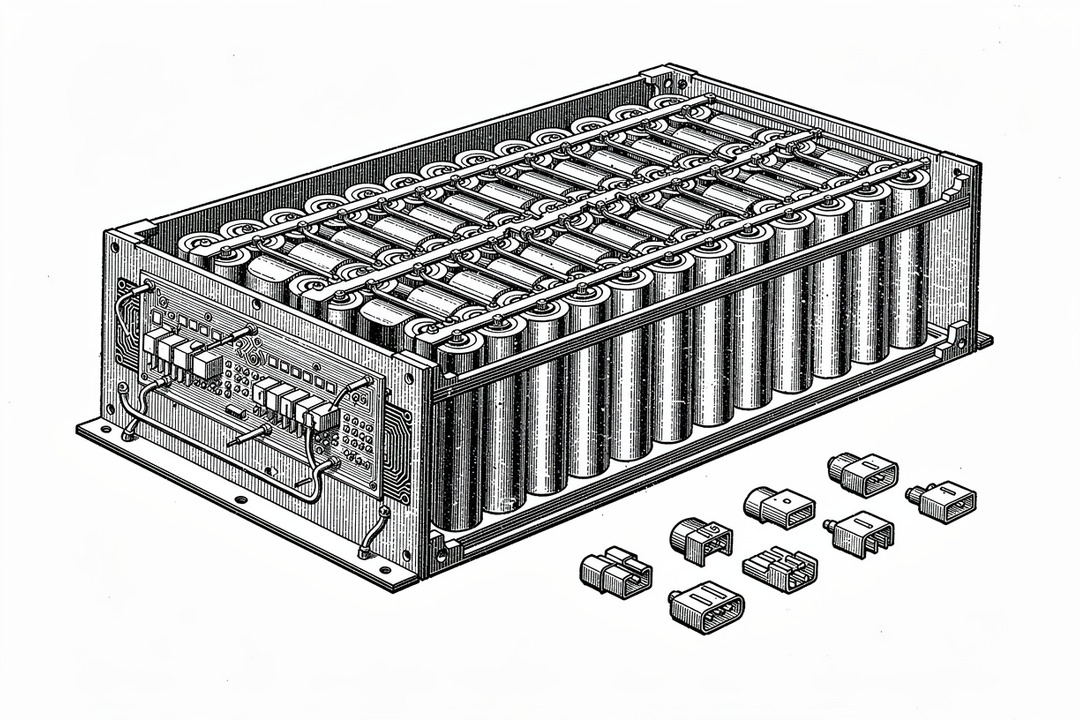
Réponse rapide : Un pack batterie lithium 48V pour un AGV ou un robot industriel se construit en choisissant une cellule cylindrique NMC, en en empilant 13 ou 14 en série pour atteindre la fenêtre de 44 à 52V que l'industrie appelle « 48V », puis en ajoutant suffisamment de groupes parallèles pour couvrir à la fois l'autonomie cible et le courant de décharge continu. À partir de là, c'est le courant continu et crête réel du pack, et non sa tension, qui détermine le palier de courant du BMS (60-80A, 100A, 150A ou 200A) et le connecteur (XT60, XT90, AS150U ou Harting MPC30/MPC60). Sauter cette dernière étape est l'erreur de dimensionnement la plus courante : un pack dimensionné uniquement pour la capacité déclenchera son BMS ou surchauffera son connecteur dès que l'AGV accélérera fortement ou se remettra d'un arrêt sur obstacle.
Ce guide parcourt toute la chaîne : calcul série/parallèle pour une cellule réelle, dimensionnement courant continu contre courant crête pour les cycles de service AGV, sélection du palier BMS et appariement du connecteur. Si vous partez de plus loin, du choix d'une chimie ou de la comparaison plomb-acide contre lithium, lisez d'abord les fondamentaux du dimensionnement des packs batterie AGV ; cet article reprend là où celui-là s'arrête et approfondit le calcul de configuration spécifique au 48V.
Pourquoi 48V est le point d'équilibre pour les AGV et la robotique industrielle
La plupart des AGV et robots mobiles de la classe de charge utile 200-1 500 kg consomment entre 1 et 5 kW en croisière, avec de courtes pointes bien au-delà lors de l'accélération ou de la récupération après obstacle. À cette plage de puissance, 48V nominal est le point où le courant reste assez faible pour une section de câble et une taille de connecteur raisonnables, sans pousser la tension assez haut pour déclencher des exigences de sécurité électrique plus strictes qui s'appliquent au-delà d'environ 60V CC sur de nombreuses plateformes industrielles.
Le compromis courant/tension aux niveaux de puissance réels des AGV
Puissance, courant et tension sont liés par P = I × U. Un système de propulsion tirant 3 kW à 24V nominal consomme environ 125A. La même charge de 3 kW à 48V nominal consomme environ 62,5A, soit la moitié du courant pour la même puissance. C'est tout l'argument en faveur du 48V par rapport au 24V pour tout ce qui dépasse un petit AMR à entraînement différentiel : moins de courant signifie un câblage plus fin, des pertes résistives plus faibles, et des connecteurs et contacteurs dimensionnés pour une classe de courant plus gérable.
Implications sur le câblage et le dimensionnement des connecteurs
Diviser le courant par deux à un niveau de puissance donné ne fait pas qu'économiser du cuivre. Cela change aussi quelle classe de connecteur convient. Un pack 24V tirant 125A a besoin d'un connecteur et d'un busbar dimensionnés pour ce courant en continu ; l'équivalent 48V à 62,5A peut souvent descendre d'un palier de connecteur complet, par exemple d'un connecteur industriel lourd à quelque chose de la classe XT90 ou AS150U. La section sur l'appariement des connecteurs ci-dessous traite cela directement.
Compatibilité de la tension d'entrée du contrôleur moteur
Avant de fixer un nombre de cellules, vérifiez la fenêtre de tension d'entrée réelle du contrôleur moteur, pas seulement son étiquette « 48V ». La plupart des contrôleurs moteur AGV de classe 48V spécifient une entrée maximale absolue entre environ 58V et 63V, car ils ont besoin de marge au-dessus du nominal d'un pack pleinement chargé. Un pack 14S d'une cellule qui charge à 4,2V par cellule atteint 58,8V à pleine charge, ce qui se situe dans une fenêtre typique de 58-63V mais suffisamment près de la limite pour devoir être vérifié par rapport à la fiche technique du contrôleur spécifique, et non supposé.
Configurer un vrai pack 48V : calcul série/parallèle pour cellules cylindriques
« 48V » est un nom de classe système, pas une tension littérale. Il couvre des packs qui se situent à peu près entre 44V et 52V nominal selon la chimie de cellule et le nombre de cellules en série, de la même façon qu'une batterie de voiture « 12V » affiche plutôt 12,6V au repos. Deux nombres de cellules en série sont couramment vendus comme packs « 48V » : 13S et 14S.
Pourquoi 13S et 14S se situent tous deux près de 48V nominal, et pourquoi le choix n'est pas arbitraire
Prenons une cellule cylindrique NMC de milieu de gamme comme l'Amprius SA17, une cellule 21700 avec 3,60V nominal, 4,20V pleine charge et une coupure de décharge à 2,75V (selon la fenêtre de test de cycle de vie de sa fiche technique). Empilez-en 13 en série et le pack se situe à 46,8V nominal. Empilez-en 14 et il se situe à 50,4V nominal, exactement une tension nominale de cellule plus haut. Les deux tombent dans la bande de 44-52V que le marché traite comme « classe 48V », et les deux fonctionneront sur les mêmes contrôleurs moteur homologués pour cette classe.
La vraie décision n'est pas « lequel est du 48V ». Les deux le sont. C'est un compromis entre trois choses : à quel point la tension pleine charge du pack se situe près de l'entrée maximale absolue du contrôleur moteur (14S fonctionne plus près de ce plafond), combien de groupes parallèles sont nécessaires pour atteindre une capacité ou un courant cible à un nombre de cellules en série donné (un nombre de série plus élevé nécessite moins de groupes parallèles pour la même puissance, car le courant diminue quand la tension augmente), et quels chargeurs et cartes BMS standards sont facilement disponibles à chaque nombre de cellules en série. Il n'y a pas de réponse universellement « correcte » ; c'est une décision système prise une fois le contrôleur et le chargeur choisis, pas avant.
Exemple chiffré : tension nominale, min et max du pack pour 13S contre 14S
En utilisant l'Amprius SA17 (21700 cylindrique, 3,60V nominal, 4,20V charge, 2,75V coupure) comme cellule d'exemple :
| Configuration | Tension min (complètement déchargé) | Tension nominale | Tension max (pleine charge) |
|---|---|---|---|
| 13S (Amprius SA17) | 35,75V | 46,8V | 54,6V |
| 14S (Amprius SA17) | 38,5V | 50,4V | 58,8V |
L'écart de 3,6V entre les deux tensions nominales correspond exactement à la tension nominale d'une cellule, puisque la seule différence entre les lignes est une seule cellule supplémentaire en série. La question pratique à laquelle ce tableau répond : si l'entrée maximale absolue d'un contrôleur moteur est spécifiée à 56V, la tension pleine charge de 58,8V du pack 14S est hors plage, et 13S est la seule option, quelle que soit la configuration qui serait sinon préférée pour le courant ou le nombre de groupes parallèles.
Groupes parallèles : dimensionner pour la capacité et le courant, pas seulement la tension
Le nombre en série fixe la tension. Le nombre en parallèle fixe la capacité et répartit le courant. Une seule Amprius SA17 fournit 6,0Ah de capacité typique et 18A de décharge continue (3C). Mettez-en quatre en parallèle (un pack 13S4P) et le groupe fournit 24Ah, soit environ 1,12 kWh à 46,8V nominal, avec 72A de courant continu et jusqu'à 120A de décharge en impulsion disponibles depuis les cellules elles-mêmes.
Ce plafond de 72A/120A au niveau cellule est un point de départ, pas le chiffre final. Il doit être vérifié par rapport à la consommation réelle en courant continu et crête de l'AGV (section suivante), et il fixe un plancher sous lequel le BMS et le connecteur doivent être dimensionnés : aucun BMS ou connecteur en aval de ce pack ne devrait être dimensionné en dessous de ce que les cellules elles-mêmes peuvent délivrer, sinon les cellules deviennent la contrainte sur le papier tandis que l'électronique devient la contrainte en pratique.
Le choix de cellule à ce stade est aussi une rotation, pas une réponse fixe. Une Reliance RS60 (21700 cylindrique, 302 Wh/kg, 50A continu / 80A impulsion par cellule) sacrifie un peu de densité énergétique pour un courant par cellule bien plus élevé, utile quand le cycle de service de l'AGV est plus axé sur le courant que sur l'autonomie. Une Molicel M65A (21700 cylindrique, 322 Wh/kg) penche dans l'autre sens, vers la densité énergétique plutôt que le courant brut. Et pour les programmes ayant déjà une relation d'approvisionnement en cellules ou une cellule déjà qualifiée dans une autre gamme de produits, les cellules fournies par le client sont une option réelle : Dan-Tech construira le pack, le BMS et la conception mécanique/thermique autour d'une cellule que le client s'approvisionne déjà, tant qu'elle dispose de données de spécification vérifiables pour concevoir autour.
Dimensionnement courant continu contre courant crête pour les cycles de service AGV
Chaque cycle de service AGV a au moins deux profils de courant qui comptent, et dimensionner pour un seul est l'origine de la plupart des packs sous-dimensionnés.
Courant de propulsion soutenu contre pics d'accélération/récupération d'obstacle
Le courant de propulsion soutenu est ce que le pack fournit en croisière, se déplaçant à vitesse constante sur un sol plat. C'est le chiffre où s'arrêtent la plupart des guides de dimensionnement. Mais les AGV accélèrent depuis l'arrêt à chaque point de passage, montent des rampes et se remettent d'arrêts déclenchés par obstacle en réaccélérant, souvent plusieurs fois par minute sur un sol chargé. Ces événements tirent 1,5 à 2,5 fois le courant soutenu pendant quelques secondes à la fois. Un pack dimensionné seulement pour le chiffre soutenu demandera à son BMS soit de limiter la puissance exactement aux moments où l'AGV en a le plus besoin, soit de déclencher un défaut de protection en plein cycle. La solution est de dimensionner le palier de courant BMS (ci-dessous) sur le profil de courant de crête, pas sur le profil moyen.
Courant d'accostage et de charge d'opportunité
Le dimensionnement côté charge est sauté presque aussi souvent que le dimensionnement de décharge de crête. Les AGV qui utilisent la charge d'opportunité, faisant le plein à une station d'accostage entre les trajets plutôt qu'une charge complète de nuit, ont besoin d'un pack qui accepte un courant de charge nettement plus élevé qu'un pack qui ne reçoit qu'une charge d'entretien nocturne. L'Amprius SA17 utilisée dans l'exemple ci-dessus accepte 3A typique (0,5C) et 6A maximum (1C) par cellule ; un pack 13S4P de cette cellule peut accepter jusqu'à 24A au niveau du pack. Si le temps d'accostage cible nécessite une recharge plus rapide que ce que cela supporte, la solution est soit une cellule à taux de charge plus élevé, soit l'acceptation d'un cycle d'accostage plus long, décidé avant la construction du pack, pas découvert après.
Choc et vibration au contact du sol contre vibration en vol
Un pack AGV vit sur roues ou roulettes, subissant une vibration continue basse fréquence et des chocs périodiques dus aux joints de sol, rampes et seuils de porte, jour après jour, pendant des années. C'est un environnement mécanique différent d'un pack de drone, qui subit une vibration haute fréquence entraînée par les hélices dans les airs mais bien moins de chocs répétés contre une structure dure. La fixation mécanique, la retenue des cellules et la protection contre les tensions du connecteur doivent tous tenir compte spécifiquement du service au contact du sol ; une conception de fixation éprouvée sur un pack de vol ne se transpose pas automatiquement.
Sélection du palier de courant BMS
Une fois le courant continu et de crête du cycle de service connus, le palier BMS en découle directement. Dan-Tech construit des packs sur quatre paliers de courant : 60-80A, 100A, 150A et 200A.
Correspondance entre classe de cycle de service et palier de courant (60-80A / 100A / 150A / 200A)
| Classe de cycle de service | Courant continu typique | Courant de crête typique | Palier BMS |
|---|---|---|---|
| Petit AMR, moteur unique, charge légère | 20-40A | moins de 80A | 60-80A |
| AGV standard, double moteur, charge moyenne | 40-70A | 80-100A | 100A |
| Classe AGV/tracteur remorqueur lourd | 70-110A | 120-150A | 150A |
| Multi-moteur, charge élevée, entraînement redondant | plus de 110A | plus de 150A | 200A |
Dimensionnez le palier sur la crête, pas sur le chiffre continu. Un pack qui croise à 55A continu mais qui pointe à 105A à chaque accélération appartient à un palier 150A, pas 100A, même si son chiffre continu correspond sur le papier au palier inférieur. Pour un aperçu plus approfondi de ce qui se trouve à l'intérieur du BMS lui-même, protocoles de communication, équilibrage et architecture de protection, voir conception BMS personnalisée.
Faire correspondre le connecteur à la consommation de courant réelle du pack
Le connecteur est le dernier maillon de la chaîne de dimensionnement, et il doit correspondre au courant réel du pack, pas à sa classe de tension. La gamme de connecteurs de Dan-Tech couvre la plage du léger à l'industriel lourd : XT60, XT90, AS150U et Harting MPC30/MPC60.
| Connecteur | Classe de courant | Adaptation typique |
|---|---|---|
| XT60 | Courant plus faible, dimensionné à environ 60A continu selon la convention de nommage | Service AMR léger uniquement, où le courant de crête reste à environ 60A ou moins : le bas du palier BMS 60-80A. Un pack de ce palier dont la crête approche son plafond de 80A a besoin d'un XT90 à la place, pas d'un XT60. |
| XT90 | Courant moyen, dimensionné à environ 90A continu | Le haut du palier 60-80A plus la majeure partie du palier 100A, où le courant de crête se situe environ entre 60 et 90A. Un pack culminant tout en haut du palier 100A, près de 100A, correspond mieux à l'AS150U. |
| AS150U | Courant élevé, dimensionné à environ 150A continu ; le connecteur Smart BMS standard de Dan-Tech, déjà utilisé sur des packs se déchargeant jusqu'à 120A | Palier BMS 100-150A |
| Harting MPC30 / MPC60 | Connecteurs multibroches de qualité industrielle, verrouillables, résistants à la poussière et aux vibrations, dimensionnés jusqu'à environ 200A selon la configuration | Palier BMS 150-200A, ou toute application nécessitant un connecteur industriel verrouillable plutôt qu'un type à broche/lame |
Le sens de l'erreur est toujours le même : sous-dimensionner le connecteur pour un courant de crête que le pack peut réellement délivrer. Un pack de palier 150A passant par un connecteur de classe XT90 fera chauffer ce connecteur à chaque événement d'accélération, bien avant que les cellules ou le BMS ne montrent le moindre stress, parce que le XT90 plafonne autour de 90A continu. Dimensionnez le connecteur sur le même courant de crête utilisé pour choisir le palier BMS, pas sur le courant de croisière, et passez à une classe de connecteur supérieure dès que la crête se situe près du haut de la plage nominale actuelle.
En quoi cela diffère d'un pack e-bike/eMobility 48V
Un pack lithium 48V pour un e-bike et un pack lithium 48V pour un AGV peuvent utiliser le même calcul série/parallèle et atteindre la même tension nominale, tout en étant deux produits très différents en dessous.
Cycle de service et environnement d'exploitation
Un pack e-bike connaît un usage intermittent, des heures en veille entre les trajets, un courant continu modéré, et un accélérateur contrôlé par le cycliste qui commande rarement une crête soutenue pendant plus de quelques secondes. Un pack AGV fonctionne par postes, parfois 24h/24, avec les pics de courant d'accélération/récupération d'obstacle décrits ci-dessus se répétant des dizaines de fois par heure, sur un sol intérieur fixe plutôt qu'un terrain extérieur variable. Le pack AGV a besoin d'un BMS et d'une conception thermique dimensionnés pour un cyclage de service soutenu, pas seulement une demande de crête occasionnelle.
Périmètre de certification
Les packs eMobility et AGV/industriels sont typiquement délimités par rapport à des ensembles de normes différents, car ils relèvent de catégories réglementaires différentes : un produit véhicule grand public par opposition à un composant de machine industrielle. Un projet peut être délimité pour répondre à l'ensemble de normes que son usage final réel exige, par exemple le marquage CE, les tests de transport UN 38.3, RoHS et la sécurité des cellules IEC 62133 pour un pack industriel, aux côtés de toute norme supplémentaire de sécurité machine ou spécifique au véhicule que le propre parcours de certification de l'intégrateur exige. Le périmètre de certification est défini par projet, en fonction du marché cible et de l'application, et non supposé à partir de la seule classe de tension.
Erreurs de dimensionnement courantes à éviter
- Dimensionner le BMS sur le courant de croisière plutôt que le courant de crête. Le pack fonctionnera parfaitement sur un sol plat et vide, et se déclenchera au premier cycle de récupération d'obstacle.
- Choisir 14S pour « plus de marge » sans vérifier la tension maximale absolue du contrôleur moteur. Un pack pleine charge à 58,8V peut se situer juste au niveau, ou au-delà, du plafond d'un contrôleur.
- Traiter le courant côté charge comme une réflexion après coup. Les AGV à charge d'opportunité ont besoin d'un pack dimensionné pour le courant de charge réel de la station d'accostage, pas seulement pour le côté décharge.
- Faire correspondre le connecteur à l'étiquette du palier BMS plutôt qu'au courant de crête réel du pack. Un BMS dimensionné pour 100A avec une consommation de crête de 150A en amont dans le câblage a quand même besoin d'un connecteur dimensionné pour cette crête de 150A.
- Supposer que « 48V » signifie une tension exacte unique. Les packs 13S et 14S portent tous deux cette étiquette ; la vraie spécification est la fenêtre de tension nominale, min et max, pas un chiffre unique.
Décisions clés : résumé
Dimensionner un pack AGV ou robotique 48V est une chaîne de décision unique et connectée, pas quatre décisions séparées :
- Classer le cycle de service : courant de propulsion continu et courant de crête d'accélération/récupération, plus le courant côté charge si la plateforme utilise la charge d'opportunité.
- Choisir la cellule et le nombre en série (13S ou 14S, le plus souvent) par rapport à la fenêtre de tension d'entrée réelle du contrôleur moteur, pas seulement l'étiquette « 48V ».
- Dimensionner les groupes parallèles à la fois pour la capacité cible et le plafond de courant au niveau cellule.
- Sélectionner le palier BMS (60-80A / 100A / 150A / 200A) par rapport au courant de crête, pas la moyenne.
- Faire correspondre le connecteur à ce même courant de crête, pas à l'étiquette nominale du palier.
FAQ
Que signifie réellement « 48V » pour un pack batterie lithium ?
C'est une classe système, pas une tension littérale. Un pack lithium de classe 48V fonctionne typiquement entre 44 et 52V nominal selon la chimie de cellule et le nombre en série ; les configurations 13S et 14S d'une cellule cylindrique NMC courante tombent toutes deux dans cette plage et sont toutes deux vendues comme packs « 48V ».
13S ou 14S est-il le bon choix pour un pack AGV 48V ?
Cela dépend du plafond de tension d'entrée réel du contrôleur moteur et du nombre de groupes parallèles que la capacité cible nécessite à chaque nombre en série. Le 14S atteint une tension nominale et pleine charge plus élevée à partir de la même cellule, ce qui abaisse le courant pour un niveau de puissance donné, mais nécessite plus de marge sous l'entrée maximale du contrôleur.
Quelle capacité de courant BMS me faut-il pour une batterie AGV 48V ?
Dimensionnez-la sur le courant de crête du pack, pas son courant de croisière. Les événements d'accélération et de récupération d'obstacle tirent régulièrement 1,5 à 2,5 fois le courant de propulsion soutenu, et les quatre paliers de Dan-Tech (60-80A, 100A, 150A, 200A) doivent être choisis par rapport à ce chiffre de crête.
Quel connecteur utiliser pour un pack batterie AGV 48V ?
Faites-le correspondre au même courant de crête utilisé pour sélectionner le palier BMS. XT60 et XT90 conviennent aux paliers légers ; AS150U, le connecteur Smart BMS standard de Dan-Tech, convient aux paliers moyens à élevés ; les connecteurs industriels MPC30/MPC60 de Harting conviennent aux paliers les plus élevés ou à toute application nécessitant un connecteur verrouillable résistant aux vibrations.
En quoi un pack AGV 48V diffère-t-il d'un pack e-bike 48V ?
Même classe de tension, cycle de service différent. Un pack AGV fonctionne avec un cyclage de courant soutenu et répété sur des postes, sur un sol intérieur fixe ; un pack e-bike connaît une demande intermittente contrôlée par le cycliste. Le périmètre de certification diffère aussi selon la catégorie d'usage final et est défini par projet.
Un pack 48V personnalisé peut-il utiliser des cellules que nous nous approvisionnons déjà nous-mêmes ?
Oui. Les cellules fournies par le client sont une option réelle lorsque le programme dispose déjà d'une cellule qualifiée avec des données de spécification vérifiables ; le pack, le BMS et la conception mécanique/thermique sont construits autour de cette cellule de la même manière qu'autour de n'importe quelle cellule du catalogue de Dan-Tech.
Ce que fait Dan-Tech : Dan-Tech Energy, fabricant de packs batterie Li-ion personnalisés avec une production en Allemagne et aux États-Unis, intègre toute la chaîne couverte dans ce guide dans chaque pack personnalisé : configuration série/parallèle adaptée au contrôleur moteur cible, palier de courant BMS dimensionné sur le cycle de service réel, et sélection du connecteur adaptée au courant de crête réel, pas seulement une étiquette de tension.
Si vous dimensionnez un pack 48V pour une plateforme AGV ou robotique, spécifiez-le avec la ToolBox et obtenez une configuration construite autour du cycle de service réel de votre plateforme plutôt qu'un modèle 48V générique. Pour parcourir d'abord les configurations existantes dans la plage 48V, consultez le catalogue de Dan-Tech.

.png)


