
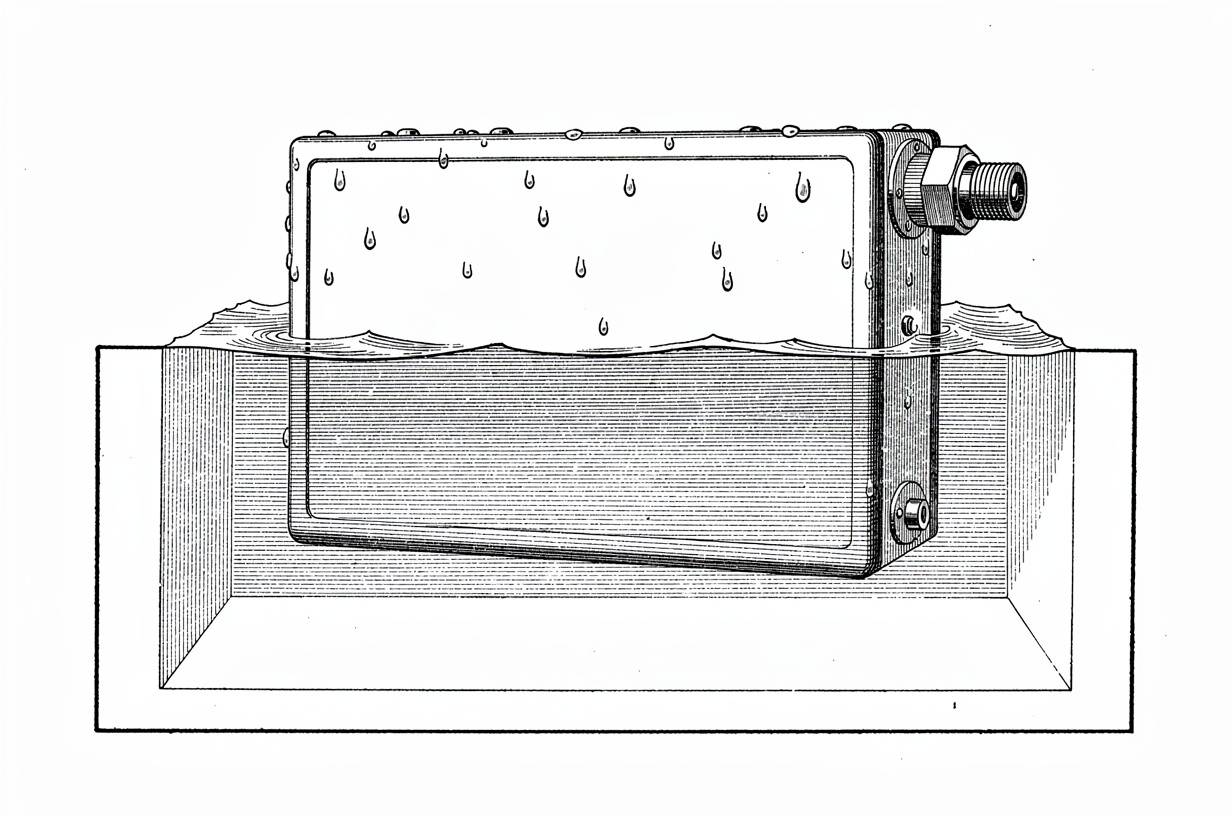
Réponse rapide : un indice IP67 ou IP68 sur une fiche technique décrit le boîtier, pas le pack batterie fini. La compatibilité du connecteur, le format de cellule, l'altitude, la durée de vie en vibration et la conception thermique sous un boîtier scellé sont tous en dehors de ce chiffre et doivent être conçus séparément. Dan-Tech Energy, fabricant de packs batterie Li-ion sur mesure avec une production en Allemagne et aux États-Unis, traite tous ces éléments comme faisant partie de la même décision de conception que le boîtier lui-même.
Un pack qui réussit le test d'immersion IP67 sur le banc d'essai échoue quand même sur le terrain. Généralement pas parce que le boîtier fuyait. Parce que le connecteur n'était pas évalué au même niveau, l'évent équilibreur de pression n'a jamais été spécifié, ou le joint n'a jamais été testé contre trois ans de vibration au lieu d'un après-midi dans un bac de test. Le boîtier a réussi. Le pack, non.
Traité comme une simple case à cocher, un indice IP est la source des défaillances terrain. Un pack est livré avec un boîtier scellé et testé. Six mois plus tard, il revient sur un formulaire de retour : corrosion au niveau du connecteur, une cellule gonflée qui a fissuré l'enrobage, un joint qui tenait le premier jour et a cessé de tenir après quatre cents cycles de vibration. Rien de tout cela n'apparaît dans un test d'immersion IP67. Tout cela apparaît sur le terrain, généralement après que le pack est déjà intégré dans le système du client et que la réparation n'est plus bon marché.
Indices IP en bref : ce que les chiffres signifient réellement
Le format à deux chiffres de la CEI 60529
Les indices IP proviennent de la norme CEI 60529 et utilisent deux chiffres. Le premier couvre la pénétration de particules solides (poussière), de 0 à 6. Le second couvre la pénétration d'eau, de 0 à 9 (9K pour le lavage haute pression et haute température, testé selon une norme connexe). « IP67 » signifie niveau 6 de protection contre la poussière (étanche à la poussière, aucune pénétration sous vide) et niveau 7 de protection contre l'eau (immersion temporaire, conditions d'essai définies). Chaque chiffre est testé indépendamment, et un indice ne certifie que ce qui a été réellement testé : un boîtier évalué IP6X uniquement pour la poussière et jamais testé en immersion n'a aucune protection contre l'eau, quelle que soit son étanchéité apparente.
IP65 vs IP67 vs IP68 vs IP69K : ce dont une application a réellement besoin
| Indice | Poussière | Eau | Ce qui est réellement testé | Convient à |
|---|---|---|---|---|
| IP65 | Étanche à la poussière (6) | Jets d'eau basse pression depuis n'importe quelle direction (5) | Jet d'eau, pas d'immersion | Équipement au sol exposé à la pluie et à la poussière, sans risque de submersion |
| IP67 | Étanche à la poussière (6) | Immersion jusqu'à 1 m pendant 30 minutes (7) | Immersion statique à une profondeur et durée définies | Drones extérieurs atterrissant dans l'herbe humide ou des flaques, robots terrestres traversant de l'eau stagnante |
| IP68 | Étanche à la poussière (6) | Immersion continue au-delà de 1 m (8) | Profondeur et durée définies par le fabricant (la CEI 60529 ne fixe aucun chiffre universel pour l'IP68) | Équipement marin, capteurs submersibles, exposition continue à l'humidité |
| IP69K | Étanche à la poussière (6) | Lavage haute pression et haute température à courte distance (9K) | Jet d'eau chaude haute pression à courte distance | Transformation alimentaire et sols industriels fortement lavés ; rarement l'exigence réelle pour la robotique aérienne ou terrestre |
L'écart à noter concerne l'IP68. Contrairement à chaque niveau inférieur, la CEI 60529 ne définit aucune profondeur ni durée fixe pour le niveau 8 : le fabricant fixe la condition d'essai et la précise séparément. Deux boîtiers peuvent tous deux porter la mention « IP68 » et signifier des choses différentes. Avant de considérer une spécification IP68 comme suffisante, demandez au fournisseur à quelle profondeur et durée elle a réellement été testée, pas seulement les deux chiffres sur la fiche.
Pour la plupart des clients de Dan-Tech, la décision réelle est plus restreinte que ne le suggère le tableau. Les drones extérieurs terrestres et les AGV opérant sous la pluie, la boue et l'eau stagnante ont besoin d'IP67. Les applications marines ou entièrement submersibles ont besoin d'un IP68 correctement dimensionné. L'IP69K s'applique presque jamais aux usages aériens ou robotiques mobiles ; c'est une spécification industrielle de lavage, et l'exiger par défaut ajoute un coût de boîtier sans mode de défaillance correspondant qui le justifie.
Le piège du connecteur et du presse-étoupe
Un boîtier IP68 entièrement enrobé est inutile si le connecteur n'est pas évalué au même niveau
C'est l'écart que la plupart des guides sur les indices IP omettent complètement : le boîtier est une voie d'entrée dans le pack. Le connecteur, le presse-étoupe et tout évent externe en sont d'autres, et chacun a besoin de sa propre évaluation de protection contre la pénétration pour que l'évaluation globale du pack signifie quoi que ce soit. Un boîtier IP68 à lui seul, associé à un connecteur non étanche, se comporte en pratique selon ce que le connecteur laisse pénétrer. La pénétration ne se soucie pas de la partie de l'ensemble par laquelle elle est entrée.
C'est aussi là où les affirmations « indice IP » deviennent imprécises dans les textes marketing en général. Un pack ne devrait jamais être décrit simplement comme « certifié IP67 » de manière générale ; la certification et la performance évaluée s'appliquent à une configuration testée, connecteur et presse-étoupe inclus, pas au boîtier isolé. L'affirmation exacte est délimitée : conçu pour répondre à l'IP67 avec une combinaison spécifique de connecteur et presse-étoupe, vérifiée pour cette construction.
Contexte d'évaluation pour les options de connecteurs réelles de Dan-Tech
Aucun des connecteurs couramment utilisés dans l'intégration des packs Li-ion ne porte par défaut la même évaluation de protection contre la pénétration, et les intégrer sans vérification dans une conception à indice IP est la version la plus courante de ce piège.
| Connecteur | Indice de protection (nu) | Courant continu / impulsion | Remarques |
|---|---|---|---|
| XT60 | Non évalué IP : connecteur bullet ouvert | Classe 60 A | Aucun joint, aucun manchon d'étanchéité. Convient à l'intérieur ou en boîtier fermé ; non protégé seul contre la poussière ou l'eau. |
| XT90 | Non évalué IP : connecteur bullet ouvert | 90 A | Même construction que le XT60 à courant plus élevé. Même exposition. |
| AS150U | Non évalué IP : connecteur bullet ouvert | 150 A | Connecteur bullet anti-étincelles. Marge de courant plus élevée, toujours aucune protection contre la pénétration propre. |
| Harting Han® MPC30 | IP40 (accouplé) | 30 A continu / 180 A impulsion (10 s) | Testé selon la norme CEI 61373 (une norme ferroviaire de choc/vibration que Harting applique pour qualifier ces connecteurs pour les environnements de vibration UAV/robotique). Compatible DroneCAN via ses contacts de données haute vitesse. L'IP40 protège contre l'accès aux outils/fils et aux gros objets solides, pas contre l'eau ni la poussière fine. |
| Harting Han® MPC60 | IP40 (accouplé) | 60 A continu / 350 A impulsion (10 s) | Même famille de boîtier que le MPC30 à courant plus élevé. Même plafond IP40. |
Le schéma est clair : même l'option de connecteur industriel le plus robuste utilisée par Dan-Tech, la série Harting Han MPC, est livrée en configuration standard en IP40, bien en dessous de l'IP67. L'IP40 arrête les outils et fils au-dessus de 1 mm ; il ne fait rien contre l'eau ou la poussière fine. Si un projet a réellement besoin que l'interface connecteur du pack tienne l'IP67, c'est un choix de boîtier/insert différent au niveau du connecteur, et cela doit être spécifié comme sa propre exigence, pas supposé parce que le boîtier environnant est scellé.
La question pratique à poser à un fournisseur n'est pas « le pack est-il IP67 ? » C'est : « quelle configuration de connecteur, presse-étoupe et évent a été réellement testée ensemble, et à quelle évaluation chaque élément de ce chemin a-t-il tenu ? » Un pack qui répond à cette question avec une réponse réelle par composant représente un niveau d'ingénierie différent de celui qui répond avec un seul chiffre sur une fiche technique.
Technologie d'étanchéité vs format de cellule : le compromis que les concurrents ignorent
Les cellules pouch évacuent et gonflent ; un boîtier IP68 entièrement scellé sans relâchement de pression enferme cette expansion
Les cellules pouch se dilatent lors du cyclage normal, pas seulement en cas de défaillance. Une cellule pouch à film comme l'Amprius SA08 (360 Wh/kg) ou la SA504 (383 Wh/kg) n'a pas de boîtier rigide contraignant ce gonflement ; le pouch lui-même fléchit. Dans un boîtier ouvert ou aéré, c'est un paramètre de conception pour lequel on prévoit un espace de dégagement. Dans un boîtier IP68 entièrement enrobé ou entièrement scellé sans chemin de relâchement de pression, cette même expansion n'a nulle part où aller, et la pression s'accumule contre l'enrobage et le joint lui-même sur la durée de vie en cycles du pack.
Ce n'est pas un défaut de la cellule. C'est une inadéquation entre une décision d'étanchéité et une décision de format de cellule prises indépendamment l'une de l'autre, ce qui correspond exactement à la manière dont les deux sont généralement décidées en pratique : l'ingénierie mécanique choisit la stratégie de boîtier, et la cellule est sélectionnée selon la densité énergétique et le coût. Aucune des deux décisions n'est fausse en soi. Prises sans référence l'une à l'autre, elles peuvent entrer en conflit.
Un boîtier cylindrique rigide se comporte différemment d'un empilement pouch dans le même boîtier scellé
Le boîtier en acier ou en aluminium d'une cellule cylindrique est une limite mécanique rigide. Des cellules comme la Molicel M65A (322 Wh/kg, format 21700) ou l'Amprius SA112 (308 Wh/kg, format 21700) évacuent quand même via leur dispositif de relâchement de pression conçu en cas de défaillance réelle, mais elles ne fléchissent pas et ne gonflent pas contre un boîtier scellé comme le fait un pouch lors du cyclage ordinaire. C'est une part importante de la raison pour laquelle Dan-Tech privilégie par défaut les cellules cylindriques NMC 21700 pour la majorité des applications, réservant les formats pouch aux cas nécessitant spécifiquement la densité énergétique supérieure qu'un format pouch comme la SA08 ou la SA504 peut atteindre, ou un facteur de forme non standard qu'une cellule cylindrique ne peut pas remplir.
Pour un boîtier scellé à indice IP spécifiquement, ce choix par défaut a une seconde justification au-delà de la densité énergétique et du conditionnement : moins de marge mécanique interne doit être conçue dans le boîtier pour tenir compte du comportement de la cellule sur la durée de vie du pack. Ce n'est pas que les cellules pouch ne peuvent pas aller dans un boîtier scellé. C'est que le faire correctement signifie concevoir la mise à l'air et le dégagement interne pour le gonflement du pouch comme une exigence de premier ordre, pas une réflexion après coup découverte pendant les essais de qualification.
Conseils spécifiques par application : drones, robotique et usage à forte décharge
Drones et UAV : mise à l'air pour l'altitude et le différentiel de pression
Une évaluation IP67 est vérifiée au niveau de la mer ou à proximité, dans un bac d'immersion statique. Elle ne dit rien de ce qui arrive au même joint lorsqu'un drone monte du niveau du sol à quelques centaines de mètres d'altitude et que le différentiel de pression à travers le boîtier change. Les applications terrestres extérieures et marines, les cas d'usage pour lesquels la plupart des guides génériques sur les indices IP sont écrits, ne rencontrent jamais cela. Le vol, si.
Un boîtier scellé sans équilibrage de pression peut stresser le joint à chaque cycle de montée et descente, et les chutes de température en altitude peuvent provoquer de la condensation à l'intérieur d'un boîtier qui n'a jamais été conçu pour respirer. Un évent équilibreur de pression de type Gore laisse passer l'air tout en bloquant l'eau liquide et la poussière, maintenant le boîtier en IP67/IP68 pour la protection contre la pénétration tout en supprimant le différentiel de pression qui agirait autrement contre le joint à chaque vol. Pour un pack drone/UAV, cet évent n'est pas un matériel optionnel boulonné après coup ; il appartient à la spécification du boîtier dès le départ, aux côtés du connecteur.
Robotique et AGV : dégradation du joint due aux vibrations sur la durée de vie terrain
Un test IP67 se produit une fois, sur une unité neuve, dans des conditions contrôlées. Un déploiement robotique ou AGV fonctionne pendant des années sous vibration mécanique continue. Les joints subissent une déformation rémanente sous charge soutenue : la capacité du matériau à reprendre sa forme et à maintenir la pression d'étanchéité se dégrade sur des cycles de compression répétés. Un joint qui tenait l'IP67 le premier jour d'un déploiement pluriannuel n'est pas garanti de le tenir la troisième année, et rien dans le rapport d'essai initial n'indique quand il a cessé.
Cela importe particulièrement pour les intégrations robotique et AGV car l'environnement mécanique (vibration moteur, chocs de roue/chenille, résonance structurelle) est soutenu et répétitif d'une manière que les charges de vol d'un drone ne sont pas. Une spécification de pack pour cette application devrait s'enquérir du matériau du joint et de la durée de vie attendue de déformation rémanente sous le profil de vibration réel, pas seulement l'évaluation IP initiale, et devrait intégrer un intervalle d'inspection des joints dans le plan de maintenance plutôt que de supposer que le chiffre du premier jour tient indéfiniment.
Décharge à fort taux C sous boîtier scellé : le compromis thermique
Sceller un boîtier pour la protection contre la pénétration et refroidir un pack sous fort courant de décharge tirent dans des directions opposées. Un boîtier ouvert et aéré évacue la chaleur par convection presque gratuitement. Un boîtier scellé IP67/IP68 bloque ce chemin de flux d'air en même temps que l'eau et la poussière, et la chaleur générée par des cellules en décharge intense, des cellules comme la Reliance RS60 (50 A continu / 80 A impulsion) ou l'Amprius SA124 (50 A continu / 180 A impulsion, évaluation 2 secondes) dans les applications drone et robotique, doit aller ailleurs.
Il n'y a pas de réponse gratuite ici, seulement un compromis à faire délibérément : refroidissement actif (ajoute du poids, de la consommation d'énergie et un nouveau composant à étanchéifier ou aérer correctement), une surface d'évent équilibreur de pression plus grande, dimensionnée à la fois pour l'échange thermique et le relâchement de pression, ou une courbe de derating de décharge qui maintient le pack scellé dans ses limites thermiques au prix de la puissance de crête. Laquelle est correcte dépend du cycle d'utilisation. Une spécification de pack qui nomme une évaluation IP cible sans nommer une stratégie thermique pour l'usage à fort courant n'a pas réellement terminé la conception.
Ce à quoi faire attention : les défaillances d'intégration que personne ne mentionne à l'avance
Facilité d'entretien terrain vs indice IP pour les packs à échange à chaud et déverrouillage rapide
Un pack entièrement enrobé et scellé en permanence est la configuration la plus simple à évaluer et maintenir en IP67/IP68, et la pire configuration pour une flotte robotique ou AGV qui doit retirer des batteries sur le terrain et en insérer une chargée en quelques minutes. Une interface de connecteur à déverrouillage rapide doit être accouplée et désaccouplée des centaines ou des milliers de fois sur la durée de vie du pack, et chaque cycle d'accouplement est une occasion d'user le joint du connecteur, de désaligner l'interface ou d'introduire des débris exactement au point où la protection contre la pénétration dépend d'un joint propre et répétable.
C'est une exigence de conception réelle à soulever avec un fournisseur avant la finalisation du boîtier, pas après : pour combien de cycles d'accouplement/désaccouplement l'interface connecteur est-elle évaluée tout en maintenant son évaluation de protection contre la pénétration, et ce chiffre correspond-il réellement à la fréquence réelle d'échange de la flotte sur la durée de vie prévue du déploiement ? Un connecteur choisi uniquement selon l'évaluation de courant et le coût, sans vérifier sa durée de vie de cycles d'accouplement évaluée par rapport à la performance IP, est une source courante d'un pack livré scellé qui cesse d'être étanche en quelques mois d'usage terrain.
Où se situe l'essai IP dans le calendrier du programme de certification
L'essai de protection contre la pénétration IP n'appartient pas à la même famille de certification que l'UN38.3 (sécurité du transport) ou la CEI 62133-2 (sécurité des cellules et batteries), et il ne suit pas le même calendrier. L'UN38.3 et la CEI 62133-2 sont des essais d'abus électriques et mécaniques effectués sur la cellule ou le pack fini dans des conditions de défaillance et de contrainte définies. L'essai IP est un essai de pénétration du boîtier, et il dépend du fait que la conception mécanique, le connecteur, le presse-étoupe et le choix d'évent soient tous finalisés en premier, car changer l'un d'eux après coup invalide l'essai de pénétration précédent.
En pratique, cela signifie que l'essai IP se situe plus tard dans le programme qu'il n'y paraît sur une liste de certification générique : il ne peut pas commencer de manière significative avant que l'intégration mécanique soit verrouillée, tandis que les essais de transport et de sécurité des cellules peuvent souvent avancer en parallèle contre la conception de la cellule et du BMS, plus tôt. Un calendrier de programme qui traite la « certification » comme un bloc indifférencié risque de découvrir la dépendance de l'essai IP à la finalisation mécanique seulement après que le calendrier a déjà été engagé. Séquencer cela correctement, et délimiter quelles normes s'appliquent à un projet donné, est exactement le type de conversation à avoir avant le début d'une construction, pas pendant.
Résumé : décisions clés
- Un chiffre IP décrit le boîtier, pas le pack. Le connecteur, le presse-étoupe et l'évent ont chacun besoin de leur propre évaluation de protection contre la pénétration pour que l'ensemble complet tienne le niveau indiqué.
- L'IP68 n'a pas de condition d'essai fixe dans la CEI 60529. Demandez à quelle profondeur et durée une spécification IP68 donnée a réellement été testée avant de la considérer suffisante.
- Faites correspondre délibérément l'évaluation du connecteur à celle du boîtier. Les connecteurs bullet (XT60, XT90, AS150U) ne portent aucune protection contre la pénétration propre ; même les connecteurs industriels Han MPC30/MPC60 de Harting sont livrés en IP40 standard, bien en dessous de l'IP67.
- Les cellules pouch gonflent lors du cyclage normal ; les boîtiers scellés doivent en tenir compte. Le boîtier rigide d'une cellule cylindrique élimine une variable de ce compromis, ce qui explique en partie pourquoi le cylindrique est la recommandation par défaut de Dan-Tech.
- Les packs drone et UAV ont besoin d'une mise à l'air équilibratrice de pression, pas seulement d'un boîtier testé pour la pénétration, pour gérer la pression liée à l'altitude et la condensation.
- Les packs robotique et AGV ont besoin d'un plan de durée de vie du joint, pas seulement d'un essai IP du premier jour. La déformation rémanente du joint dégrade la performance d'étanchéité sur des années de vibration.
- La décharge à fort taux C sous boîtier scellé impose un véritable compromis thermique entre refroidissement actif, dimensionnement de l'évent et derating. Nommez la stratégie, pas seulement l'évaluation cible.
- Les packs à échange à chaud réparables sur le terrain ont besoin d'une durée de vie de cycles d'accouplement évaluée sur le connecteur, vérifiée par rapport à la fréquence réelle d'échange de la flotte, en plus de son évaluation de protection contre la pénétration.
- L'essai IP dépend de la conception mécanique finale et ne suit pas le même calendrier que l'UN38.3 ou la CEI 62133-2. Séquencez-le explicitement dans le plan du programme.
- Ne décrivez jamais un pack fini comme « certifié IP67 » de manière générale. Délimitez l'affirmation à la configuration testée de connecteur/presse-étoupe/évent, ou utilisez « conçu pour répondre à l'IP67 ».
FAQ
Quelle est la différence pratique entre IP67 et IP68 pour un pack batterie ?
L'IP67 signifie que le boîtier survit à une immersion temporaire jusqu'à 1 mètre pendant 30 minutes, un essai fixe et défini. L'IP68 signifie une immersion continue au-delà, mais la CEI 60529 laisse la profondeur et durée exactes au fabricant à spécifier, donc deux affirmations IP68 ne sont pas automatiquement équivalentes. Demandez à quelle profondeur et durée une évaluation IP68 spécifique a été réellement testée.
Un boîtier évalué IP68 signifie-t-il que le pack batterie entier est IP68 ?
Pas à lui seul. Le connecteur, le presse-étoupe et tout évent sont des chemins de pénétration séparés, et chacun a besoin de sa propre évaluation correspondante. Un boîtier IP68 scellé associé à un connecteur non évalué se comporte selon ce que le connecteur laisse pénétrer, pas selon l'évaluation du boîtier.
Une cellule pouch peut-elle aller dans un boîtier scellé à indice IP ?
Oui, mais le boîtier doit tenir compte du gonflement du pouch lors du cyclage normal comme une donnée de conception, avec un dégagement et, si nécessaire, un relâchement de pression. Le boîtier rigide d'une cellule cylindrique élimine cette variable spécifique, ce qui explique en partie pourquoi Dan-Tech recommande par défaut les cellules cylindriques 21700 et réserve les formats pouch aux applications nécessitant spécifiquement la densité énergétique supplémentaire.
Les batteries de drone ont-elles besoin d'évents équilibreurs de pression même si elles sont déjà IP67 ?
Pour les UAV capables d'altitude, oui. Une évaluation IP67 est vérifiée près du niveau de la mer. La montée change le différentiel de pression à travers le boîtier à chaque vol, ce qui stresse un joint entièrement scellé et peut provoquer de la condensation interne. Un évent équilibreur de pression de type Gore supprime ce stress tout en préservant l'évaluation de protection contre la pénétration.
Où se situe l'essai de pénétration IP par rapport à l'UN38.3 et la CEI 62133-2 ?
C'est une famille d'essais séparée avec son propre calendrier. L'UN38.3 et la CEI 62133-2 évaluent la sécurité des cellules et du pack sous conditions d'abus et de défaillance et peuvent souvent avancer en parallèle avec la conception mécanique. L'essai IP exige que la conception mécanique, le connecteur, le presse-étoupe et les évents soient finalisés en premier, car tout changement ultérieur invalide l'essai de pénétration. Séquencez-le explicitement dans le plan du programme plutôt que de supposer qu'il se déroule en parallèle des autres normes selon le même calendrier.
Concevoir le boîtier, le connecteur, la mise à l'air et le format de cellule comme une seule décision plutôt que quatre décisions séparées est exactement le travail d'intégration qu'un fournisseur de boîtier IP générique ne fera pas pour vous. La ToolBox de Dan-Tech est le point de départ de cette conversation. Pour voir les formats et configurations de cellules disponibles pour construire, parcourez le catalogue de packs batterie Lithium-Ion.

.png)


