
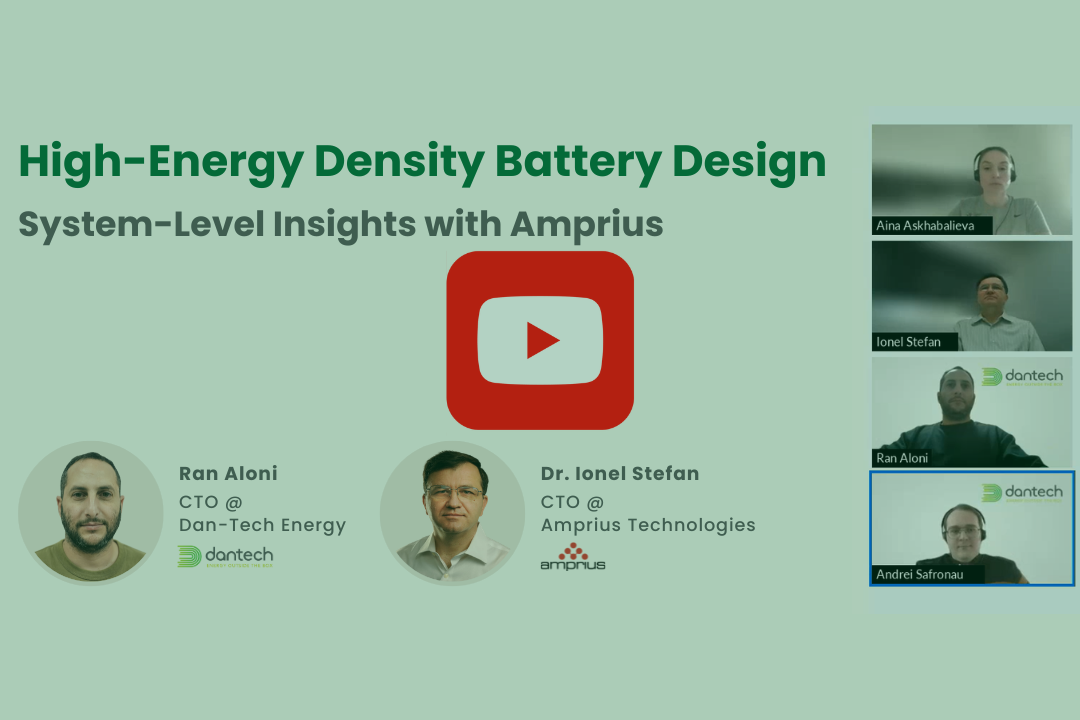
High-energy density cells are opening new possibilities for drones, robotics, aviation, and other advanced battery-powered systems. But higher energy density does not automatically translate into better product performance. It also changes how a battery pack must be designed, integrated, cooled, protected, and certified. That was the central message of our recent webinar with Dan-Tech Energy CTO Ran Aloni and Amprius CTO Dr. Ionel Stefan. You can watch the full recording [here].
Why battery design matters
One of the strongest points from the webinar was that a cell datasheet is only the starting point. Once cells are joined into a battery pack, system-level decisions begin to affect safety, reliability, certification, and performance. Dan-Tech’s presentation highlighted that battery choice impacts efficiency, power output, lifespan, fire risk, overheating behavior, and regulatory compliance. It also made the case that custom battery design is often the best way to fully match the battery to the product, rather than forcing the product around an off-the-shelf pack.
That system view becomes even more important when working with high-energy cells. Ran emphasized that battery design starts with requirement analysis: current profile, runtime, peak loads, charging method, communication protocol, user replaceability, operating environment, and certification path all influence the final pack architecture.
Start with the mission profile
The webinar made clear that the “best battery” depends on the actual application. In UAVs and aviation, for example, power demand is rarely constant. VTOL, hovering, pusher configurations, mapping drones, inspection drones, and long-endurance platforms all place different demands on the battery. Designers need to balance payload versus capacity, power density versus energy density, thermal management, connector strategy, hot swapping, and certification.
This is why battery design cannot be separated from use case. A battery that performs well in a long, stable cruise profile may not be the right fit for a power-heavy takeoff-and-landing mission. The webinar repeatedly returned to this point: system performance depends on matching the cell and pack design to the actual duty cycle.
Why silicon anode are attracting so much attention
From the Amprius side, Dr. Stefan explained why silicon continues to be one of the most important directions in lithium-ion cell development. Conventional cells typically use graphite on the anode side, where lithium ions are stored through intercalation. Silicon can store far more lithium than graphite, which is why it is such a strong path toward higher specific energy. In the webinar, Amprius described silicon as having roughly ten times the lithium storage capacity of graphite.
But that gain comes with a major materials challenge. Graphite expands relatively little during lithiation, while silicon expands dramatically more. As Dr. Stefan explained, that swelling must be managed through the structure of the anode and the overall cell design. This is why high-energy density cells are not just about choosing a new material. They depend on solving a full materials-and-manufacturing problem.
Specific energy is about whe whole cell, not one material
Another key insight from the webinar was that specific energy is not determined by chemistry alone. Amprius explained that there are only two main ways to improve specific energy: increase the contribution of active materials, or reduce the share of inactive materials in the cell. In practice, that means gains come not only from better anodes and cathodes, but also from better cell architecture, lighter supporting structures, and a more efficient active-to-inactive material ratio.
That idea connects directly to system-level design. During the Q&A, both speakers noted that pack-level components can easily erode the gains achieved at cell level. Enclosures, protection electronics, thermal management hardware, and BMS components all add weight and volume. In other words, teams can invest in premium cells and still lose energy density at pack level if the rest of the battery is not engineered carefully.
Power, energy, and application fit
The webinar also addressed a common misconception: high-energy density does not mean power no longer matters. For electric flight especially, takeoff and landing often demand high power, while cruise rewards high energy. Amprius showed that once power for these peak phases is available, additional Wh/kg can directly extend useful mission range. Dan-Tech complemented that view by showing how different UAV classes have very different power chart shapes and therefore need different battery strategies.
That is why application fit matters so much. Some systems benefit most from endurance, others from burst power, and many need a balance of both. The value of high-energy density cells depends on whether the application can actually convert that added specific energy into longer runtime, lower weight, or better mission capability.
Safety and certification must be built in early
The webinar also reinforced that safety and compliance cannot be treated as late-stage tasks. Dan-Tech’s presentation covered the need to design packs that can withstand vibration, impact, short circuits, and electronic interference, while also preparing for transport and product certifications such as UN38.3, IEC 62133, UL, CE, and battery identification requirements.
A useful practical point from the session was that certification should influence design decisions early, including voltage level, pack segmentation, and mechanical architecture. Ran noted that staying below 60V or splitting systems into lower-voltage modules can sometimes simplify the certification path, depending on the application.
Final Thoughts
The big takeaway from the webinar was simple: high-energy density battery design is not only about chasing a higher Wh/kg number. It is about translating advanced cell technology into a battery system that is safe, manufacturable, certifiable, and truly optimized for its application. That means thinking at both levels at once: cell-level innovation and system-level design.
Want to explore the topic further? The full webinar recording is available here
In today’s demanding applications, BMS design is not optional but it’s strategic. From safety and performance to real-time data and compliance, a thoughtfully designed BMS unlocks product potential and ensures reliability in the field.
At Dan-Tech Energy, we help customers bridge exactly this gap between cell capability and pack-level reality. From requirement analysis and cell selection to BMS, thermal design, prototyping, and certification support, our team helps turn advanced battery technology into reliable products.
-----
Ready to take your battery system to the next level? Try our intuitive ToolBox Technology to kickstart your custom battery design.
Stay informed: Subscribe to our newsletter to keep up with battery tech, case studies, and expert insights from Dan-Tech Energy.

.png)


