
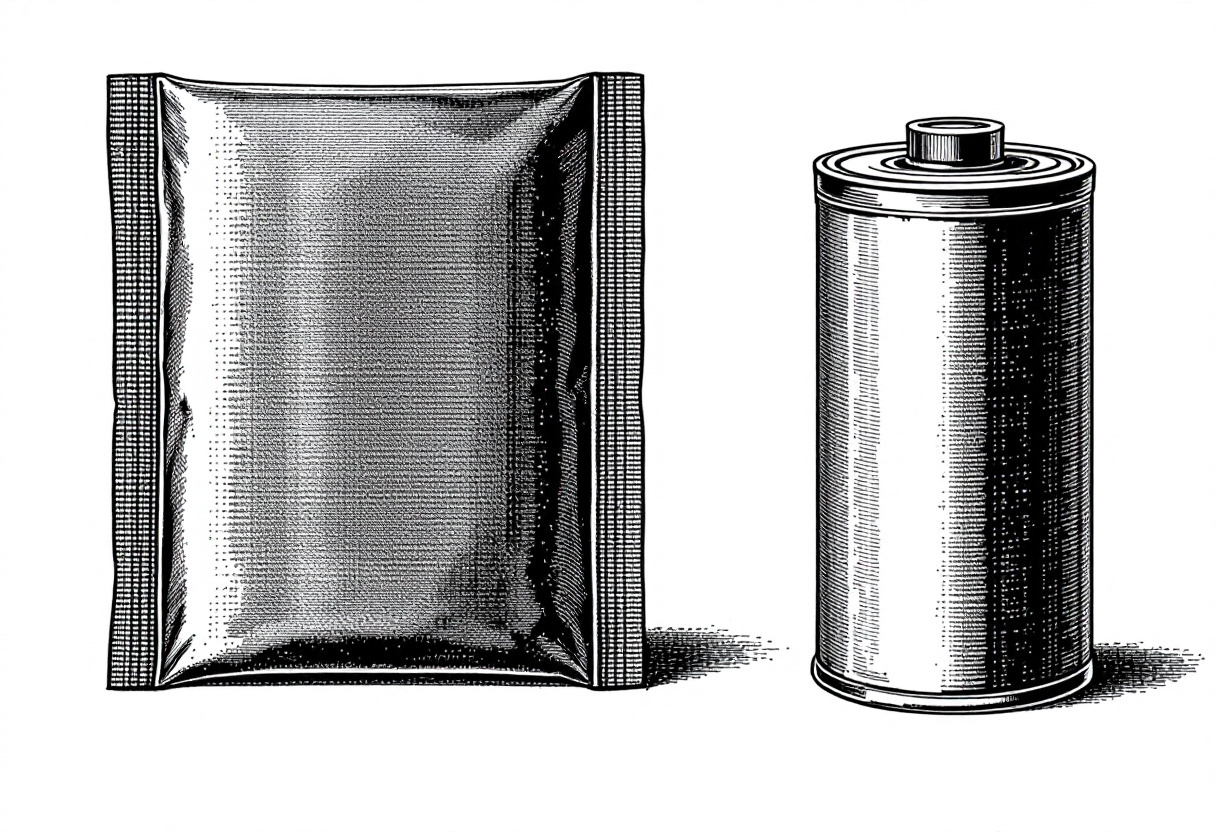
The conventional wisdom has been clear for years: pouch cells for energy density, cylindrical cells for robustness. That trade-off drove design decisions across UAV, aerospace, and industrial applications. It is becoming less accurate. This post explains what has changed.
Why Pouch Cells Dominated: The Original Argument
The case was always energy density. Without a heavy steel canister, pouch cells pack more energy per gram than cylindrical cells of the same chemistry. For a decade, that advantage was decisive. A 5–15% gravimetric energy density improvement translated directly into longer flight time, higher payload, or a smaller pack for the same energy content.
For weight-critical platforms, HAPS, long-endurance fixed wing, aerospace, that delta was the difference between a platform that met its endurance target and one that did not. Engineers accepted the trade-offs: custom form factors, rigid enclosure requirements to manage swelling, single-supplier dependency, longer lead times, and higher minimum order quantities. The energy density was worth the complexity. That calculation is being revisited.
What Has Changed: The Energy Density Gap Is Closing
This is the core of the argument. The numbers make it concrete.
| Cell | Format | Gravimetric Energy Density | Type |
|---|---|---|---|
| Amprius SA08 | Pouch | 360 Wh/kg | Silicon anode |
| Amprius SA11 | Large pouch | 353 Wh/kg | Silicon anode |
| Molicel M65A | 21700 cylindrical | 322 Wh/kg | NMC |
| Amprius SA17 | 21700 cylindrical | 300 Wh/kg | Silicon anode |
| Molicel P60C | 21700 cylindrical | 288 Wh/kg | NMC, high power |
| Molicel P50S | 21700 cylindrical | 260 Wh/kg | NMC, max power |
Five years ago, 300+ Wh/kg required custom pouch cells. Today the Molicel M65A delivers 322 Wh/kg in a standard 21700 cylindrical format, and the Amprius SA17 reaches 300 Wh/kg in cylindrical using silicon anode chemistry. That is not a marginal shift. These were pouch cell numbers.
The gap that made pouch cells worth their complexity now only exists at the extreme end: 350+ Wh/kg applications like HAPS and ultra-long-endurance aerospace. Below that threshold, modern cylindrical cells cover the energy density requirement. Engineers who defaulted to pouch cells because “cylindrical can’t match the energy density” should rerun that calculation with current data.
The Advantages Cylindrical Always Had
Thermal predictability. The steel canister constrains cell geometry during cycling. Cylindrical cells do not swell. Thermal events are contained within the can. Pouch cells expand under cycling and gas generation, adding enclosure design complexity and making thermal events harder to manage.
Safety. In a thermal event, a cylindrical cell vents through its vent mechanism in a controlled direction. A pouch cell under thermal stress can rupture along the laminate seam, with less predictable venting geometry and force. For aerospace, defence, and regulated commercial applications, the containment properties of cylindrical cells are a genuine safety advantage.
Mechanical robustness. Cylindrical cells are self-contained structural units. They do not require a rigid housing to maintain their integrity. Pouch cells must be constrained in an enclosure that manages swelling under cycling, adding weight, design complexity, and a fatigue failure mode. In high-vibration environments (UAV, industrial equipment, mobile robotics), cylindrical cells have a well-documented field track record.
Supply chain maturity. 21700 cylindrical cells are produced at scale by multiple manufacturers: Molicel, Samsung SDI, Amprius, and others. If a supplier has lead time issues, you can qualify an alternative without a tooling change. Custom pouch cells involve specific tooling, specific suppliers, longer lead times, and higher minimum order quantities. Single-supplier dependency on a custom pouch format is a real production risk.
Field validation. Cylindrical cells have been deployed at scale across electric vehicles, power tools, UAV, and industrial equipment for over a decade. The failure modes are documented. BMS design patterns are established. Pouch cells at comparable deployment scale have a narrower field history.
Where Pouch Cells Still Make Sense
Absolute maximum energy density (>320 Wh/kg required). If the application genuinely requires more than 320 Wh/kg, HAPS, ultra-long-endurance fixed wing, extreme weight-critical aerospace, the Amprius SA08 at 360 Wh/kg and SA11 at 353 Wh/kg are the only available option. No commercial cylindrical cell currently matches this level.
Non-standard form factor. If the product enclosure cannot accommodate 21700 cylindrical geometry, curved fuselage sections, distributed layouts with irregular cavities, custom pouch cells designed around the available volume may be the only viable path.
Large single-cell capacity. The Amprius SA11 delivers 30,750 mAh per cell in large-format pouch. Applications that require very high per-cell capacity have a legitimate reason to use pouch format.
The Decision Framework: Three Questions
1. Does your application require more than 320 Wh/kg?
If yes, evaluate pouch: the SA08 and SA11 are the only cells that deliver above this threshold. If 260–322 Wh/kg covers the requirement, cylindrical cells meet the spec.
2. Does your form factor require non-standard geometry?
If yes, evaluate pouch. If standard 21700 cylindrical dimensions fit the enclosure, the design simplification is significant: no swelling management, no custom tooling, no single-supplier constraint.
3. Is this a production program with supply chain and service life requirements?
If yes, cylindrical cells’ multi-supplier ecosystem, standardised dimensions, and field-validated reliability reduce program risk.
For most commercial UAV, industrial robotics, and performance applications, the answer to all three questions points to cylindrical.
Key Decisions: Summary
- The energy density gap has closed at most operating points. The Molicel M65A at 322 Wh/kg and Amprius SA17 at 300 Wh/kg in cylindrical format deliver energy densities that required custom pouch cells five years ago.
- Cylindrical cells’ thermal, safety, mechanical, and supply chain advantages were always real. With the energy density gap closed, they now outweigh the trade-off for most applications.
- Pouch cells remain correct for applications requiring more than 320 Wh/kg, non-standard form factors, or very large single-cell capacity.
- For commercial UAV, industrial, and performance applications: the case for cylindrical is stronger now than it has ever been.
Dan-Tech Energy’s primary product line is cylindrical 21700 format across Molicel, Samsung SDI, and Amprius cells. Use the ToolBox to define your requirements and get a straight answer on whether cylindrical covers your spec. Explore the full range at our Li-Ion battery pack catalog.

.png)


