
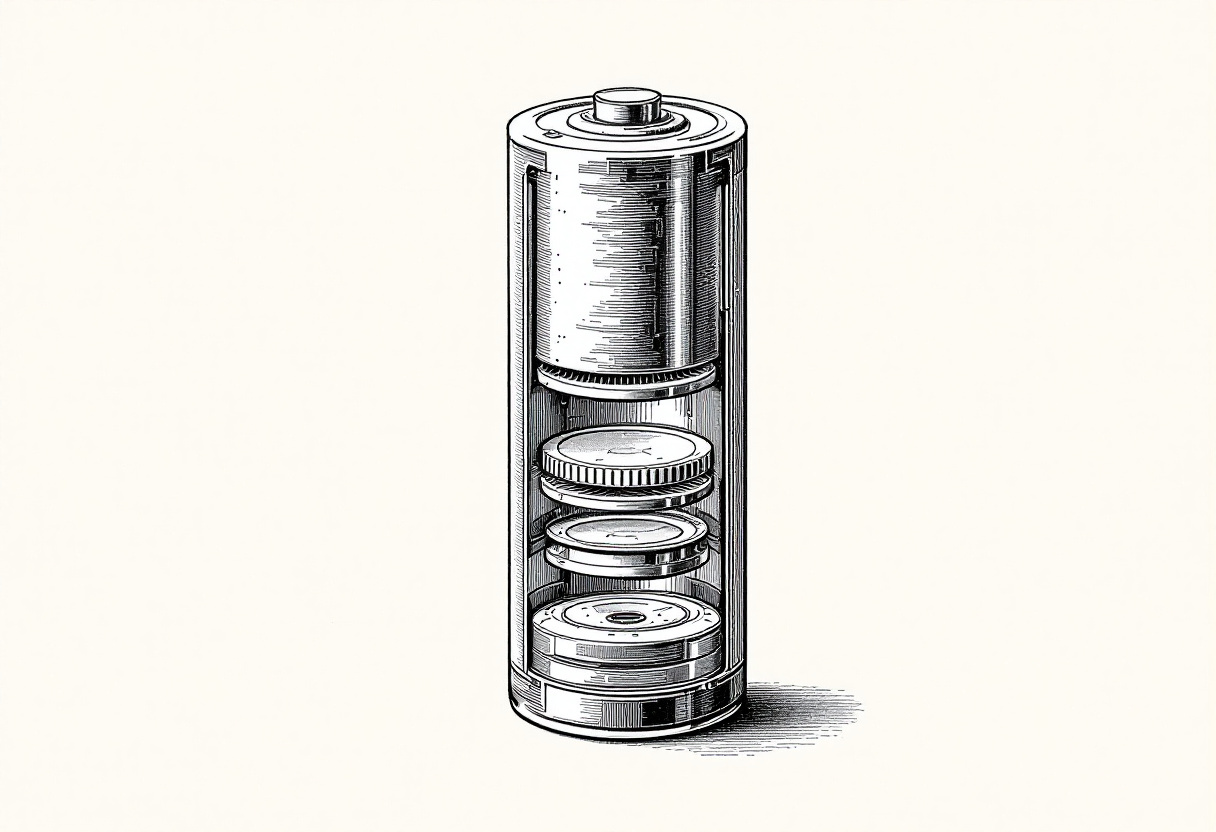
Silicon anode cells carry two reputations among engineers: exceptional energy density, and short cycle life. The first is accurate. The second, for the Amprius SA17, is not.
This post explains what the chemistry actually delivers, where the real trade-offs are, and which applications justify the premium.
What Makes Silicon Anode Cells Different
Graphite has a theoretical capacity of 372 mAh/g. Silicon has a theoretical capacity of approximately 3,580 mAh/g, nearly ten times higher. That gap is why silicon anode cells attract attention from engineers building weight-critical systems.
In practice, you cannot use pure silicon. Silicon expands by up to 300% during lithiation. That volume change causes cracking, electrode degradation, and rapid capacity loss. Manufacturers blend silicon with graphite, or use structured architectures, to manage the expansion.
Amprius uses a silicon nanowire architecture. The nanowires accommodate volumetric expansion more effectively than standard silicon-graphite composite blends. The result is a cell that captures the energy density benefit of silicon without the cycle life penalty that has historically made silicon anode cells impractical.
The Amprius SA17, a 21700 cylindrical cell, achieves 300 Wh/kg. Standard NMC 811 in 21700 format delivers 250–270 Wh/kg. That is approximately 15% more energy density in the same form factor. Not 30–50%, as some supplier claims suggest. 15% is the real number.
The Trade-Offs: What You Actually Give Up
Many posts on silicon anode batteries misstate the trade-offs. Here is what is accurate for the SA17.
Cost
Silicon anode cells cost more per Wh than standard NMC cells. The premium is real and varies with order volume and supplier. If your program is cost-constrained, this matters. If it is weight-constrained, it may not.
Availability
Amprius cells are not commodity components. You cannot pull SA17s from a distributor shelf the way you can pull standard 21700 NMC cells. Lead times and minimum order quantities differ from standard supply. Design procurement into your timeline.
Cycle life, correcting the industry myth
Silicon anode cells are widely assumed to have shorter cycle lives than graphite cells. For the SA17, this is not accurate. The SA17 is rated at 600 cycles at +0.5C charge / -1C discharge, 4.2–2.75V. That is comparable to NMC 811, not shorter. The nanowire architecture manages expansion well enough to preserve cycle life at rated conditions. The cost premium and procurement complexity are the real trade-offs, not cycle life.
Cell Comparison
| NMC 811 (21700) | Amprius SA17 | Molicel M65A | |
|---|---|---|---|
| Anode chemistry | Graphite | Silicon nanowire | Graphite |
| Energy density | 250–270 Wh/kg | 300 Wh/kg | 322 Wh/kg |
| Capacity | ~4,800 mAh | 6,000 mAh | 6,500 mAh |
| Continuous discharge | 10–14A typical | 18A (3C) | 26A |
| Cycle life | 400–600 cycles | 600 cycles | Not published |
| Cost per Wh | Moderate | High | Moderate–High |
| Commercial availability | High | Limited | Moderate |
| Format | 21700 cylindrical | 21700 cylindrical | 21700 cylindrical |
| Best for | General performance | Weight-critical, long-endurance | High energy density without silicon anode complexity |
One data point worth noting: the M65A at 322 Wh/kg is actually higher energy density than the SA17 at 300 Wh/kg, despite being an NMC cell with no silicon anode. Engineers who need high energy density and want to avoid silicon anode procurement complexity should evaluate it seriously.
Which Applications Actually Benefit
Not every weight-critical application benefits from silicon anode. The relevant question is whether energy density is the program constraint, and whether the cost and procurement overhead are acceptable.
High Benefit: Silicon Anode is the Right Call
HAPS (High-Altitude Pseudo-Satellites)
Every gram saved is additional flight time or payload. Cycle counts are low: HAPS platforms do not cycle batteries daily. Cost is secondary to performance. SA17 (300 Wh/kg) covers most cylindrical-format HAPS designs. For large-format platforms where cell volume allows, the SA11 (353 Wh/kg, 30.75 Ah per cell, large pouch) delivers more energy per kilogram and is built specifically for aerospace applications.
Long-endurance fixed-wing UAV (missions over 4 hours)
Energy density is often the primary design constraint for long-endurance platforms. A 15% improvement in Wh/kg directly translates to extended mission duration or reduced take-off weight. When NMC 811 pack mass is the bottleneck, SA17 removes it.
eVTOL with strict weight budgets
Vertical takeoff is energetically expensive. Pack weight affects hover efficiency, range, and payload capacity. For programmes with tight weight budgets, the SA17’s energy density in cylindrical format is a meaningful advantage.
Defence UAV where endurance outweighs cost
Defence procurement tolerates higher component costs when they deliver mission-critical performance gains. Long-endurance loiter, extended surveillance, and persistent ISR all benefit from higher Wh/kg. Cycle life at these use cases is typically not the constraint.
Moderate Benefit: Evaluate Carefully
Commercial inspection drones
Useful if the NMC 811 pack is the limiting factor for flight time. If the mission profile fits within what NMC 811 delivers, the cost premium is hard to justify. Run the numbers on actual flight time versus pack mass before committing.
High-C-rate discharge platforms
SA17 is rated at 18A continuous (3C). If your peak and continuous discharge requirements fall within that envelope, SA17 works. If your platform demands 4C or 5C continuous, look at the Amprius SA08 (54A continuous in pouch format) or the Molicel M65A (26A continuous in 21700).
Low Benefit: Stick With NMC 811 or M65A
High-cycle-count applications
SA17 delivers 600 cycles. At 200 cycles per year, that is three years of service life. At 400 cycles per year, it is eighteen months. If your platform cycles heavily, model service life explicitly before selecting SA17. The cycle life is comparable to NMC 811, but neither cell is the right choice for high-cycle industrial applications without a replacement plan.
Budget-constrained programmes
The cost premium for SA17 is substantial. If NMC 811 pack energy meets the mission requirement, the additional cost does not buy additional capability. Match the cell to the constraint.
Platforms where energy density is not the constraint
If range, endurance, and weight budgets are satisfied by NMC 811, silicon anode adds cost without adding a meaningful outcome. The goal is to remove a constraint, not to use the highest-spec cell.
SA17 in Cylindrical Format: A Key Advantage
Silicon anode cells have historically been available in pouch format. Pouch cells offer high energy density but introduce design complexity: they swell during cycling, require mechanical containment, and have less predictable thermal behaviour than cylindrical cells.
The SA17 changes this. It is a silicon anode cell in standard 21700 cylindrical format.
Cylindrical cells have contained thermal events. A cell-level thermal event does not propagate to adjacent cells the way it can in a pouch pack. Mechanical behaviour is predictable. There is no swelling to manage at the pack level. Pack designs built around 21700 cells are compatible with multi-supplier sourcing strategies.
For engineers who want silicon anode energy density without switching to pouch format, the SA17 is the current answer. You get 300 Wh/kg in a format with 18 years of cylindrical cell production data behind it.
Dan-Tech’s silicon anode range extends beyond SA17. The SA08 (360 Wh/kg, pouch, 54A continuous) covers high-power applications requiring maximum energy density. The SA11 (353 Wh/kg, large pouch, 30.75 Ah per cell) is built for HAPS, aerospace, and eVTOL at scale. The SA110 (290 Wh/kg, 18650 cylindrical) fits space-constrained applications where the 21700 format is too large.
SA17 specs:
| Parameter | Value |
|---|---|
| Energy density | 300 Wh/kg |
| Capacity | 6,000 mAh |
| Continuous discharge | 18A (3C) |
| Cycle life | 600 cycles (+0.5C / -1C) |
| Voltage range | 4.2–2.75V |
| Format | 21700 cylindrical |
| Anode | Silicon nanowire |
Key Decisions: Summary
- SA17 delivers approximately 15% more energy density than NMC 811 in 21700 format. Not 30–50%. 15%.
- The cycle life trade-off cited for silicon anode cells does not apply to SA17. 600 cycles is comparable to NMC 811.
- The real trade-offs are cost premium and procurement complexity.
- Best fit: weight-critical platforms where energy density is the programme constraint and cost is secondary.
- If energy density is not the bottleneck, NMC 811 or M65A is a simpler and cheaper choice.
- The M65A at 322 Wh/kg beats SA17 on energy density and is an NMC cell, worth evaluating for engineers who want high energy density without silicon anode procurement overhead.
- SA17 is available in 21700 cylindrical format. You do not need to switch to pouch to access silicon anode energy density.
Dan-Tech Energy supplies Amprius SA17 cells and builds custom packs with lead times as short as 3 weeks from confirmed spec. Use the ToolBox to define your requirements and get a direct answer on what is achievable. For the full range of high-energy-density options, explore our premium Li-Ion pack catalog.

.png)


